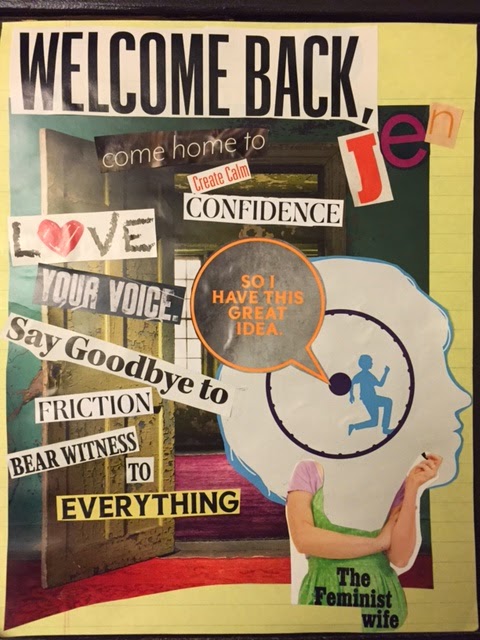
It’s nothing new to wake up one day and realize, shit, I don’t know who the fuck I am anymore. And then think, shit, did I ever know? I’m not the first woman to get married, buy a house, have a kid, sell a house, move a couple more times, buy another house, have another kid, and then suddenly look at her husband and not be able to remember what it was she liked about him all those years ago before marriage, house, and family. To look at herself in the mirror and think, what the fuck have you done to yourself? To look around at everyone else and think, what do they have that I’m just not seeing here?
Domesticity does not become me. I never dreamed about becoming a mother; it was never my goal to get married, have kids, and live unhappily ever after, the way it seemed my mother, and her mother before her had. I work full time; some (and by some I mean all) might even say I work triple time: consulting on the weekends and moonlighting for a local college at night, not to mention keeping house and grocery shopping and loving my children. I don’t feel guilty about working more than I see my kids. I find myself wishing I had more time to myself more often than I wish I had more time to spend with them. I couldn’t have stayed home with them, and I eschew the whining, wheedling, and weariness of the dinner, bath, bedtime routine. I used to dread weekends and snow days–stuck home all day with two children? What would I do to pass the time? The anger I felt at the mountain of domestic chores a house and a family require is the anger I imagine the narrator of Suzanne Buffam’s poem, “Enough” struggles to contain:
“I am wearing dark sunglasses inside the house
To match my dark mood.
I have left all the sugar out of the pie.
My rage is a kind of domestic rage.
I learned it from my mother
Who learned it from her mother before her
And so on.
Surely the Greeks had a word for this.
Now surely the Germans do.
The more words a person knows
To describe her private sufferings
The more distantly she can perceive them.
I repeat the names of all the cities I’ve known
And watch an ant drag its crooked shadow home.
What does it mean to love the life we’ve been given?
To act well the part that’s been cast for us?
Wind. Light. Fire. Time.
A train whistles through the far hills.
One day I plan to be riding it.”
The thing is, as much as I grew to understand my mother’s rage, I had hoped to learn from it and avoid falling into the same traps that had created such a monster inside her. And yet, the thing is, even those of us who hope to create a life less ordinary may find themselves succumbing to norms–because fighting is hard, and giving in is easy–at least, in the short term. But resignation easily turns to rage, and rage suppressed long enough turns to stone. And I’ve been bent under the weight of that stone for far too long.
The problem with casting off the stone, for me at least, lay in trying to figure out what it was I wanted to fight for. “What does it mean to love the life we’ve been given?”–or the one we chose? It’s not like I regretted motherhood; quite the contrary: my children have been the light guiding me out of the tunnel I’d dug for myself. But I have never fancied myself a very good actor, and the part that has been cast for me needs a lot of tweaking.
So I’m going off script: I’m taking the play into my own hands. I’m striving to re-envision the life I want to have, and once I have seen it, I’m getting on the train to get to it.
 (mostly) full disclosure