 |
| Note: this essay was originally published in POW: The Power of Words (2014), an anthology of writing from the Connecticut Writing Project summer labs and fellows. |
“Do you like a massage?” the woman at the nail salon asked me after I sat down at the manicurist’s table, about to get the the rare manicure I do before a special event: a good friend from work was getting married in a few days. I figured I couldn’t do that much damage to my nails in three days, could I?
“Yes, thank you,” I answered, closing my eyes and trying to relax. It wasn’t often that I had time to just sit and read a book or blog, catch up on my email, or just sit, eyes closed, and enjoy being pampered. While my husband was good at taking care of things, lately I hadn’t felt like letting him take care of me–too many strings attached for that to feel right. The woman had surprisingly good hands that found the knots in my neck and shoulders right away. After a preliminary sweep of my back, she pulled my shirt away from my neck in order to better access my left shoulder. Suddenly, I heard her cluck as she pulled my shirt down farther. I opened my eyes, wondering what she was doing and slightly alarmed at the presumptuous way she was peering down my shirt.
“Oh! Look!” she said to the woman on the other side of the table, who stood up to peer down my shirt as well. I tried to ignore the glances of the other clients in the shop who were looking my way.
My manicurist sucked her teeth and sat back down. “My daughter–her neck,” she said, shaking her head in disapproval and returning to work on my hands.
“Um-hmm,” I said, empathizing with her. “My mother doesn’t like tattoos either.” This was about as much conversation as her limited English would allow, so I sat through the remainder of my manicure in silence, slightly proud of the reaction my tattoo had caused and slightly ashamed at this stranger’s apparent disapproval.
This contradiction of pride and shame had prevented me from actualizing my desire for a tattoo for 20 years, until finally, after telling my youngest sister about the tattoo I had been considering for the past two years and my fears of my mother’s reaction to it, she looked at me and said, “Jenny, you’re almost forty years old. I think you can get a tattoo if you really want one.”
As ridiculous as her retort sounded, my fears ran deep. After my best friend, Amy, the one friend my mother had liked and trusted throughout my tumultuous high school years (during which she trusted none of my friends and barely allowed me to go out on the weekends unless it was with Amy), came home with a tattoo around her ankle, my mother said to me, “My biggest fear in life is that you’ll come home with a tattoo and tell me you’re a lesbian.” When I was 20 years old, this might very well have been the case, had my fear of her disapproval not been so great. In college, I minored in Women’s Studies, which in the mid-90s had a prerequisite of eschewing all men, it seemed. And while I did shun most men, I knew I could never bring a woman home to meet my mother. So, I fixated on a tattoo, a lesser act of rebellion that might not result in my mother disowning me but would establish my independence from her all the same.
While I had wanted a tattoo since I was 18, I was also incapable of making an irreversible decision. When trying to decide where to go to college, I didn’t want to go to Ann Arbor because it was too far away. I couldn’t pick Northwestern University because it meant I’d have to agree to live at home for another year, maybe more. So I went to Loyola University instead, where I would get free tuition as a faculty dependent and could work to pay for my living expenses on campus. In college, although my rebellious nature flourished philosophically, I couldn’t get my hair cut with bangs because it would take too long to grow them out if I hated them, much less dye it with Manic Panic like the rest of my friends were doing. I couldn’t commit to a full year abroad my junior year, so I settled for a semester instead. I was insanely attracted to a girl who lived in the suite next to mine, but I was ridiculously afraid of what my straight suite mates would say if I hung out with her. Deciding what image I wanted permanently drawn on my body and where it should be drawn seemed an insurmountable task.
Still, the idea of it haunted me for many years. When Amy decided that the flash tattoos she’d gotten at 18–an octopus on one foot and an anklet with various ocean creatures on the other–were no longer relevant, considering she hadn’t gone into marine biology as she once had planned, she was determined to have her cover-up work done by an artist who owned a tattoo shop named Butterfat Studios. She talked about this artist, a woman named Esther, for three years before I finally took matters into my own hands. The thing about Amy is, she has been the older sister I never had, the mother I’d always wished I’d had, and my best friend through the hardest years of my life. If I needed a ride, she provided it. If I needed a place to hide from my mom, she threw out the welcome mat. When I thought I’d drown in the undertow of my mother’s criticism, she taught me how to swim parallel to shore to get out of its pull. And because she is so self-sufficient, finding ways of repaying her kindness are few and far between. I thought if I could get in touch with this artist and set up a time to consult with her about Amy’s tattoos, I could accomplish two goals in one: do something Amy would appreciate and get to work on my own tattoo.
Amy wanted to get one of her legs tattooed with field sketches of the herbs she grew in her garden: Thai basil, mint, rosemary, thyme, and sage. I envied the ease with which she found something meaningful to get tattooed. I wanted my tattoo to have meaning, but there was nothing I did or liked that seemed suitable: a bicycle? a book? pen and paper? flowers? what flowers? my favorite flower? did I have a favorite? Irises…I liked irises, but the only person who’d ever brought me irises was a nerdy, overly sentimental boy who I’d gone on two dates with before our brief tryst ended with a night of awkward failed sex. I definitely did not need a permanent reminder of that brief yet horrifying moment. Plus, most sketches of irises too closely resembled female genitalia a la Georgia O’Keeffe. What about a lotus? I always liked the lotuses at the Botanic Garden. Or were those water lilies? I had double-minored in Eastern religion and had always felt an unexplainable connection with Hindu mythology. Although I loved the drawings of the Hindu gods and goddesses, the ones who resonated with me most were some of the least desirable images: Shakti, the mother goddess, I admired for her embodiment of feminine creative power (very important for a girl who had majored in English with a concentration in Creative Writing), but abhorred the illustrations of crude violence and rawness; Ganesha, the destroyer of evils and obstacles, I loved for his symbolism of education, knowledge, and wisdom, yet I loathed the contradiction of his cartoonish trunk and eerily feminine eyes. The lotus, which featured prominently in all of these images, seemed like the perfect symbol. In addition, the different colors of the lotus had significance in Buddhism, a philosophy I embraced much more than the Protestantism of my upbringing. Some research into the different color symbolism of the lotus made me even more certain this was the right choice: I could do something to represent the different stages of life I’d accomplished and what I’d learned along the way as a daughter, wife, and mother. I finally settled on the idea of three lotus flowers in various stages of bloom: a closed purple lotus to represent my budding spirituality, which had not yet taken root when I was a daughter; a semi-open blue lotus which signified my growing wisdom as a wife; and a fully open red lotus to illustrate the way becoming a mother made me fully embrace compassion and love. I was settled, then, and awaited the date of our consultation with Esther eagerly.
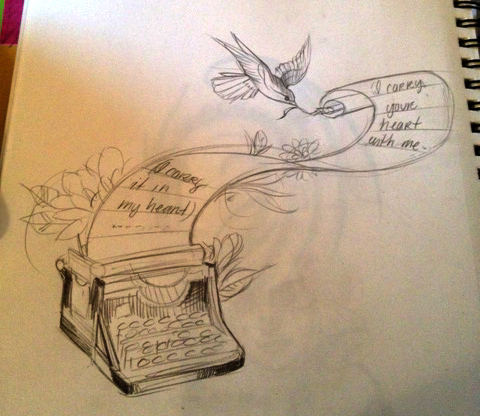
What I hadn’t anticipated, however, was that Esther, an artist who only did custom work, would not be as enthusiastic about my idea as I was. When we met to talk about our ideas, she was in her “food phase”–in other words, she was mostly interested in drawing food, ergo would only accept new projects involving food. Although she let me down gently, explaining that she had tattooed a lot of lotuses on a lot of people and never really felt satisfied with her ability to draw them, she let me down nonetheless: she wouldn’t agree to create the design for me. For someone who was already insecure about the idea of committing to an image on her body for the rest of her life (that her mother would see and likely judge every time she saw it), this crushed me. I spent the next several years alternatively thankful (that Esther had saved me from getting a cliched tattoo I would regret for the rest of my life) and wistful (for the tattoo that I had thought so long and hard about and would never see realized). Finding another artist to visualize my idea was out of the question. Esther’s work paralleled no other: her touch was light, her illustrations looking more like fine art than traditional ink. I was determined to come up with a better, more original idea; one that Esther would approve of. Since I would never have my mother’s approval, it was imperative that someone else validate my vision. I was fully aware that a more secure person wouldn’t have needed such external validation, but I’d seen enough bad tattoos to know I didn’t want to end up on the receiving end of the kind of criticism I found myself making (mostly in my own head) about others. During this time, I came across a hand-drawn sketch of an Underwood typewriter that I became obsessed with. After the hundredth such discussion with Amy and my husband about what kind of tattoo I should get, they both suggested I get a typewriter tattoo: after all, I had been a writer for as long as I could string a sentence together, I taught students to love writing and to love reading others’ writing, and all symbolism aside, vintage typewriters had beautiful mechanics.
I spent months considering the idea, knowing that I wanted to incorporate flowers into the design somehow, not quite ready to totally give up on the lotus flower and its symbolism, but also concerned that the typewriter would be too boring without some kind of colorful accents. I gathered images of lotuses and vintage typewriters. Then a bird appeared, and suddenly I was fixated on finding the right kind of bird to include in the design. A hummingbird? A nightingale? An owl? Which type of bird would best signify wisdom, creativity, and freedom? Did it matter? Which type of bird would be the prettiest? Did that matter more? About a year into the hunting and gathering, my son was born and I started rereading e.e. cummings as if I had been introduced to his poetry for the first time. These two events have no obvious connection, other than my relationship with my husband was suffering and I was turning to all memorabilia to try to remember why I’d married him in the first place. On my dresser was a framed poem by e.e. cummings, which a close friend had read at our wedding ceremony: “silently if,” which ends with the following lines:
losing through you what seemed myself;i find
selves unimaginably mine;beyond
sorrow’s own joys and hoping’s very fears
yours is the light by which my spirit’s born:
yours is the darkness of my soul’s return
–you are my sun,my moon,and all my stars.
The problem was, in rereading this poem, I was acutely aware of how much I had lost myself in my marriage. I had looked to my husband to define who I was, and now, twelve years (or twenty, including all the years before we were married) later, I didn’t like the definition I’d asked him for. While I still loved the words, I was uncomfortable with their meaning, unless I thought about how they defined the love I now had for my children. This was, I realized, the way I felt about so many of e.e. cummings’s supposedly “romantic” poems, especially one of my favorites, “I carry your heart.” Even more than “silently if,” “i carry your heart” resonated with me as a love song from a mother to a grown child, or a promise from one person to another who no longer features prominently in her life. Moreover, this was the way I felt about so many of the people in my life: I carried their hearts, through all of my decisions, actions, and thoughts. Even as I contemplated getting a tattoo my mother would hate, I wanted to try to create something she might be proud of. Even after I moved away from my parents and sisters, I spoke with them almost every day. Even as I weaned my daughter, I continued to put her needs above mine. As I struggled to connect with my husband, I thought constantly of the pain it would cause him for me to leave. Although I couldn’t leave my husband for the woman I had fallen unexpectedly in love with, I cared for her deeply. “i carry your heart with me. (i carry it in my heart.)” I needed to have these words in my tattoo. Finally, the ideas came together like the minute pieces of an infinite jigsaw puzzle. As soon as I was settled on the different elements that needed to be incorporated, I had no patience for waiting until the next time I went to Chicago to entreat Esther to complete the design for me. The artist who had done my husband’s tattoo was very good, but I wanted a female artist, so I called one of his partners and sent her my references. We agreed to meet in a week, after she’d had some time to sketch something.
During the forty-minute drive to the shop, I bounced nervously in my seat, speculating about what she might have drawn. Not a visual artist, I had no idea how to artfully draw a bird, a lotus flower, a typewriter, and the script into one design. I had placed all of my trust in the artist who’d agreed to sketch my tattoo. We pulled into the parking lot and I grabbed our daughter, Ella, who had already noticed the window-sized fish tank at the front of the shop and was eager to get inside for a closer look. My palms were sweating and I greeted her with a soggy handshake.
“Come on in!” she greeted me cheerily. We made small talk for a few minutes, greeting the other artists, who we knew through mutual friends. Finally, we sat down to look at her sketches.
“So,” she began, “I was thinking that trying to replicate the entire typewriter would be really difficult, so I thought about trying to represent just the keys instead. I think the essence of the typewriter is really all you need, with a focus on the bird and flowers. What do you think?” she asked me, handing me the tracing paper on which she’d drawn the initial sketch.
My stomach dropped to the floor and sweat immediately began to pool in the bottom of my bra. I could feel my heart pounding as I struggled to find a way to respond without belying my true feelings. “Um,” I started, then cleared my throat. “Uh…ok. So this is sort of a crest?”
“Yeah,” she said, “I wasn’t sure where you wanted the flowers, so I used that as the background for the whole piece. The stamens of the lotus I turned into the keys, with the hummingbird hovering above. I think this is a nice rendering of the concept, don’t you?”
Nice rendering? I thought in a panic. The bird looked as if it had been poisoned. The crest looked more like a police badge than a flower. This just isn’t meant to be, I admitted to myself. Why can’t anybody bring the jumbled, mixed up images in my head into some beautiful order on the page? Somehow, I excused myself from the shop, promising to call the next day to set up an appointment to get the actual tattoo inked.
I sobbed the entire way home, certain I’d never get the tattoo I’d always wanted yet unwilling to let the idea go. In between tears, I texted a picture of the botched sketch to my friend Amy. “This is a ridiculously wrong and bad vision of my design. WTF?”
Within minutes, Amy sent back a picture she had drawn. “This is more like what you want, isn’t it?”
Although her drawing was crude, it was exactly what I wanted. “YES!!!” I wrote back. “What the hell, why haven’t you drawn this for me before???”
“I’m a terrible artist,” she texted me.
“Beg to differ,” I wrote, then, “xoxo–emailing it to Esther NOW!”
By the end of the week, I heard back from Esther’s assistant, although I hadn’t known at the time that she even had an assistant. “Thanks for getting in touch. Unfortunately my plate is full, and I’m unable to consider any new projects. I would recommend getting in touch with my friend and colleague, Stephanie Brown. She could do something really beautiful for you.” Apparently, Esther had gotten so popular and had so many clients, Amy included, who were continuously booking her time to get more work done, that she had an assistant who screened her emails for her. I had, unbeknownst to me, gotten a stock rejection letter. Initially disappointed since this was now the second time Esther had turned me down, I begrudgingly looked up Stephanie’s portfolio online. My spirits lifted as soon as I discovered her electronic copies of her Moleskine sketchbooks. I had been writing in Moleskines for the past several years, and I would be lying if I didn’t admit I felt this similarity with Stephanie to be kismet. Perhaps the problem all along hadn’t been my design ideas; it had been my choice of artist. Some relationships just aren’t meant to be, I realized.
As I scrolled through Stephanie’s tattoo work, I felt an incredible connection to the images she’d drawn: birds, flowers, wildlife; unearthly creatures; designs–and all on other women. The shading she accomplished on black tattoos made me confident in her ability to beautifully render the entire typewriter; her choice of color in the floral designs was just as impressive. She drew the most beautiful birds I’d ever seen. I crossed my fingers, closed my eyes, and composed an email to Stephanie, explaining when I’d be in town to get the work done, and the limited amount of time I would have to complete it. Would she be interested?
Coincidentally, her official reply arrived in my inbox on my birthday–another “godwink,” as my mother called them–signs that things are happening the way they are meant to. She was interested, willing, and available!
For the next two months, Stephanie and I emailed details back and forth: I sent pictures of my shoulder, where we agreed the tattoo should be placed because of its size and design, and Stephanie responded with questions, locking in the elements I wanted to include. I sent my deposit, and Stephanie sent…nothing. I began to get nervous, imagining her design would emulate Laura’s and crush my spirits once again. Finally, we made our way home to Chicago for the summer. A few days before my appointment, I called the studio to check in. Stephanie promised she’d have the design finished at least a day before my appointment, so that she could make any changes necessary. At last, I got the email with the sketch. It was…perfect. Even better, now that Stephanie had completed the sketch, she was reasonably confident we would be able to finish the entire tattoo in one sitting. I cried tears of relief and slept soundly the night before my appointment.
As she had expected, Stephanie started and finished the tattoo in under four hours. I chatted with Amy and another friend of ours, Sarah, to pass the time while Stephanie worked, and my kids played under the watchful eye of one of Amy’s friend’s daughters at their nearby apartment. I had planned on staying with Amy for the next two nights with the kids so as to avoid my mother while wearing a conspicuous bandage over the tattoo as well as to enlist Amy’s help in applying ointments and lotions to help it heal. After almost 20 years, I had finally grown a pair big enough to establish my independence from my mother. All that was left to do was tell her about it.
 (mostly) full disclosure