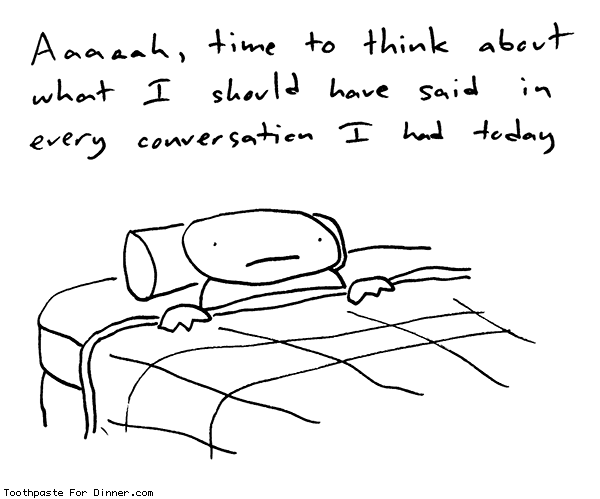
The last few minutes before lights out can be a crapshoot in our house; on any given night my five-year-old is kicking the wall and crying that he’s scared or whining that he is thirsty or appearing like a specter in his big sister’s doorway, wondering if he can sleep in her bed tonight. My daughter, on the cusp of the ‘tween years, grappling with emotions she isn’t quite ready to deal with on a daily basis, sometimes falls apart at bedtime. Maybe she can’t find her hairbrush, or maybe she’s upset about something that happened at school. The year before her father and I got divorced, she complained constantly about stomachaches and headaches, heaving great sobs as we tried to tuck her in, confessing she “just felt like something really awful was going to happen, but didn’t know what it could be.” Clearly, her parents’ fears and uneasiness about the future were rubbing off on her.
Now, bedtime remains, for her, the only time in her day when she feels safe falling apart (which is either a testament to her strength and resilience, or the result of her parents telling her to suck it up one too many times in her short lifetime). It is also one of the few times when she has either of our attention, mostly undivided (see spectral appearances above). But now that the dust has settled, and Daddy’s new house feels like home (almost) as much as Mommy’s, bedtime drama is more mundane: “But why can’t we foster a puppy?!? You promised we could foster a puppy this summer!” or “How come little brother gets to do everything and I always get in trouble for doing nothing??!!??”
Although we are used to the DEFCON levels rising quickly, my family, understandably anxious about the fallout they assume our divorce will one day have, have scapegoated it for every quirk of behavior they observed in our children this summer while they were visiting in the Midwest (without either of their parents) (for close to two weeks). So when her father accidentally reset her phone password remotely the night before I was scheduled to reunite with them, resulting in the phone reverting to the last known user (me) and populating with my text messages, and she understandably (to us) had a meltdown worse than Chernobyl, my mother and sister thought the world was ending. The reason? They thought she must have read my text messages and was freaking out because she had read something about the women I was dating. (Because apparently my mother and my sister think I’m some kind of post-divorce lesbian playgirl.) No matter what I said (the kids had held up remarkably well for ten days without their parents; it’s no surprise something so trivial would set her off; she often melts down at bedtime over trivial things; there were no text messages of the sort they were worried about, anyway), their fears about what the children would think about their parents dating other people, and in particular, their mother dating other women took front row.
It’s these fears that children mimic, not because they also have them, but because they pick up on the emotions of the adults in their lives–and my children seem especially perceptive to this. So when my mother interrogated my daughter about what she had read, she unwittingly made my daughter more anxious–not because my daughter was thinking there was something in the text messages that she shouldn’t be seeing, but simply because she knew her text messages had vanished, and that she had clicked something she probably shouldn’t have, and that she might have caused the problem by doing so. My mother–my entire family, in fact–seem to consistently misunderstand a basic fact about children: their fears and concerns are self-focused, and usually have nothing to do with other people unless those people are going to be disappointed or angry at them. They don’t know enough yet to be worried about things like whether their parents are dating women, men, or circus clowns. They don’t know any different than what they see, know, and are taught.
In our household, before and after our divorce, our children have seen gay couples and straight couples; they know heterosexual couples who are married and ones who have chosen never to marry but are nevertheless committed to one another; they have celebrated same-sex and heterosexual friends who have married; they know gay moms and are friends with the kids of these gay moms; when we talk about dating, we are sure to mention that they may choose to date people with the same gender as them as well as people with different genders. They know I dated a woman or two before I married their dad; they know their dad dated others before me as well. So when I told my sister I didn’t think it was going to be a big deal for my children to find out their mom was dating a woman, I was shocked when she replied, “Well then you must be very naive and selfish.”
Unable to adequately respond at the time, I found myself wishing I could have videotaped the conversation I had with my daughter a week ago, when she casually asked me (as she has occasionally since the divorce) if I thought her father or I were going to marry anyone else.
“Sometimes people just date for a while, you know,” I told her. “They don’t always get married right away.”
“Well, then, is there anyone that Daddy likes?” she asked me shyly. “Like, a girlfriend?”
After pressing her for a few more details about what she was noticing, trying to engage her interest and validate her observations but not wanting to share details with her without talking it over with her father first, I told her she should ask him. “Fine, I will!” she laughed. “I just keep forgetting!”
Later, as I was scratching her back in bed, I asked her, “Is it weird to think about Mommy and Daddy having girlfriends?”
This made her roll over with a sly smirk. “Then, is there someone you like?” We played a cat-and-mouse game for a few minutes while she tried to get details out of me, finally giving in and guessing the name of a woman I’d recently introduced them to. Once the cat was out of the bag, so to speak, she veered off into other topics, wondering what she should wear to camp the next day, confirming that I would get up early enough to braid her hair into two french braids as I had all week long, and making sure I packed the red Doritos, not the blue ones, for lunch.
Just before I said goodnight, she mumbled, “It’s not weird to think about you and Daddy having girlfriends, but it’s just, a little weird to think about having another mom and another dad–or two new moms.” This prompted another fifteen minute conversation, of course, during which it was clear that her concern was not whether she would have a new mom and a new dad or two new moms, but that she was trying to wrap her head around what having a new parent would be like. I assured her that nobody her father or I dated would be a new parent so much as a new family friend (and maybe, one day, a new family member)–someone she could go to if she wanted to confide in someone other than her parents. This was an answer she could relate to, and as she contentedly rattled off the names of our friends, friends’ parents, and other extended family we’ve surrounded our children with throughout their lives, I knew the kids were going to be all right.
 (mostly) full disclosure