Friday mornings at Harborview Market have become a weekly routine of late, a time and space to sit and talk and create with the cofounders of the storytelling collective my two friends and I began over a year ago. While on FMLA leave of absence from my job to recover from not one, but two surgeries to fix a seemingly small problem that revealed itself to be a big problem, I’ve certainly been living the life of Reilly. I’ve grown fond of having friends over for tea midday, lounging on the couch watching movies with company because we could. My living room has become a salon, hosting on more than one occasion the opportunity to lay down some truth on each other. This morning, my friend texted after we disbanded, as one of us usually does, to say just how very much she loves and is grateful for us. But then she tacked on, even though we hadn’t talked about it or even acknowledged the fact that I am going on week 13 of a would-have-been-six-week FMLA leave, “I love how you needed DOUBLE surgery to finally ‘let go’…our egos are mad killer.” And she’s right–there are times when each of us needs to let go a bit and let ourselves be driven by our id, but our egos keep trying to tighten the reigns. Our brains overthink our experiences, and we talk ourselves out of things rather than find out where the experience may lead. As the main character in Nick Hornby’s film High Fidelity realizes not a moment too soon, committing to nothing and keeping one’s options open is “suicide. By tiny, tiny increments.” But what happens when you commit yourself to something, and your ego talks you out of looking for options within that commitment? Why does commitment have to mean complacency?
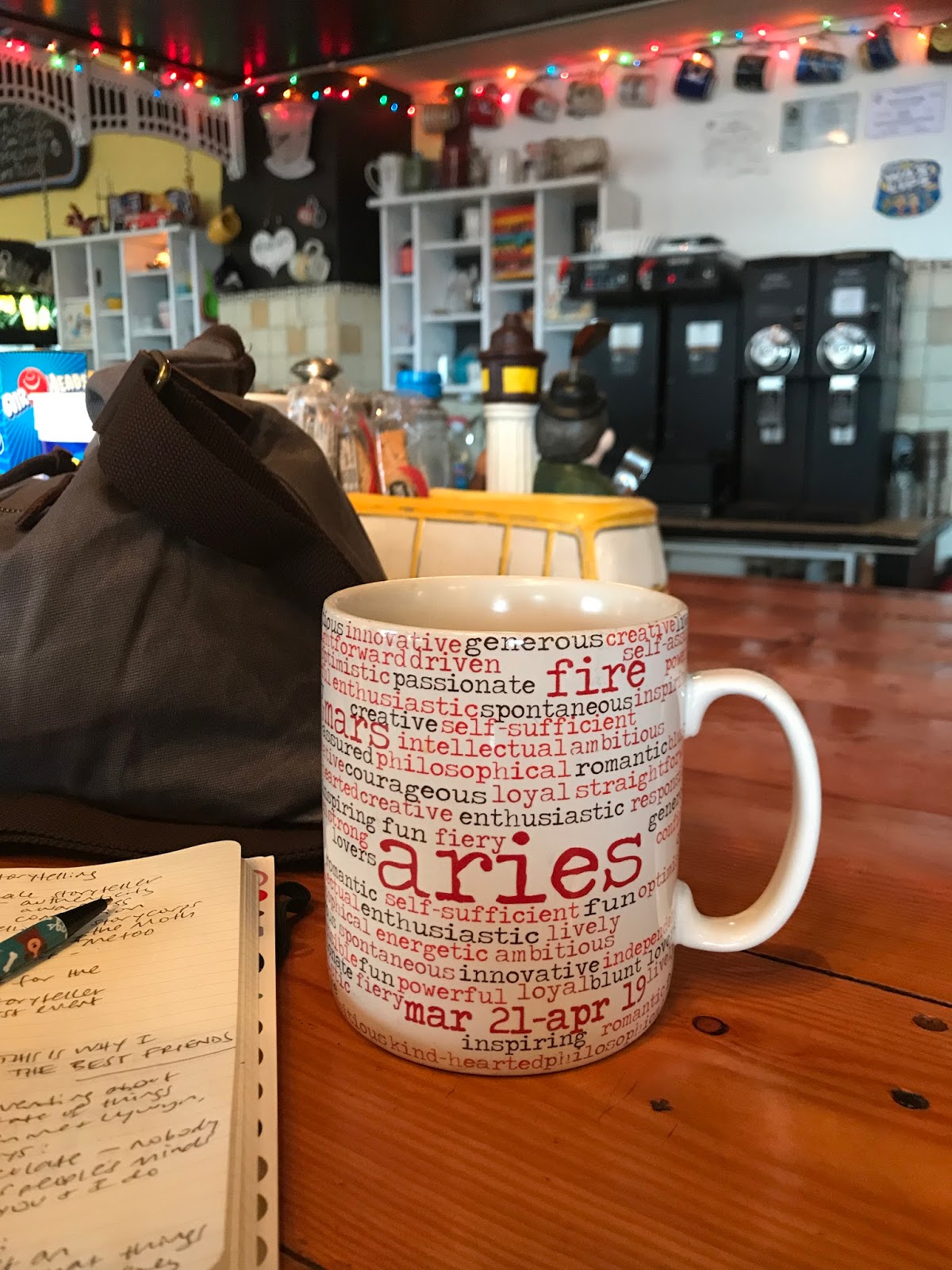
I continued on my way that morning lost in my thoughts, and didn’t find a focus until twenty minutes into sipping a hot cider at my next stop–a local coffee shop where I was meeting up with another beloved friend who had fresh eggs and frank conversation to share. Right before she walked in, I found myself shaking my head at the mysterious ways of the universe. Here I was, grappling with questions of what I wanted and what I needed out of love–and the barista unconsciously selects this gigantic mug to set in front of me. As I read the words, each one an accurate description of who and what I was, I realized how simple the answer to my questions was. Passionate, driven, fiery, philosophical, loyal, blunt–just a few of the words that describe an Aries personality. No wonder I pounded on closed doors, shouted through double-paned windows until I could make someone unlock and open them.
My entire life I have been pounding my head against these barriers, depriving myself of things because I tried too hard to convince myself that they were not necessities rather than focusing my energy on making myself heard. I haven’t adequately communicated with partners, friends, and family because most of the partners I have had and pretty much my entire family have always scoffed at me, brushed off my complaints or requests as frivolous or particular. The message I internalized early on in my life was, “get with the program.” But I always felt like I was getting the channel switched on me–the program I was getting with and feeling in sync with was not the program those around me were watching. Because I hyperfunction and most of the world does not, I tell myself it is my curse to notice every little thing out of order, to need everything to live in its own place. I tell myself it is my responsibility to adapt to the way others live, rather than to expect others to meet my needs.
Thankfully, my good friends–and they’re the best ones–don’t sell me this same bullshit. Although my friends never hesitate to call me out on mine, they also have only my interests at heart when I bring them these dilemmas. Discussing the latest with them over coffee this week has made me realize–it isn’t fear of commitment that is suicide. It is living in fear that my needs won’t be met. Operating under this assumption equals the slow, painful death of any relationship that matters to me. If my expectations are unspoken, of course I’m going to be continually disappointed. So rather than live in fear that I won’t get what I ask for, I’d rather keep asking. At least then, I’ll know whether I’m standing in front of a door locked with several deadbolts and a security chain, or a door that might easily open once I turn the handle.
 (mostly) full disclosure