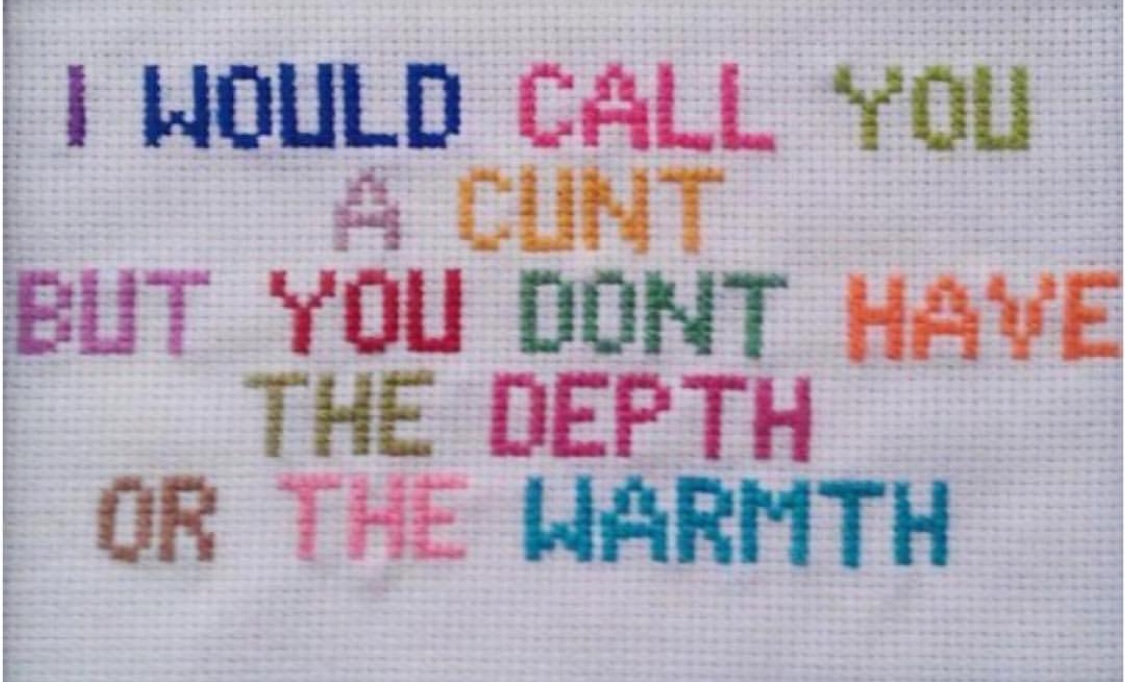
 One of the questions people will ask divorcees in an effort to help them cope with arguments that continue to occur over things that are not even arguments or interesting topics or anything of importance whatsoever is, “Would you rather be right, or would you rather be happy?” I keep trying to be happy, to ignore the 600-word text messages I receive weekly from my ex that contain threats like “obtain a lawyer” and “call the truancy officer” and “court.” In fact, I’d love to block my ex-husband’s number entirely. Unfortunately, because we have two beautiful, quirky, fabulous children together, we desperately need to find a way to treat each other with a respect we never seemed to be able to communicate to each other. But when I receive the 30th email in 13 weeks accusing me of overstepping boundaries (whose, it’s not clear), in which my parenting is questioned repeatedly (effectively, overstepping the actual boundaries established by divorce), it’s hard not to engage. So even after thousands of dollars of therapy, it appears I might rather be right. I can’t help but try to get the last word in with him, even though when I refrain from responding, I can see how my radio silence makes the word count of his text messages shrink.
But I digress. Noting the growing, not waning, animosity my ex has for me is important because I have a book I want to write. I’ve been thinking about writing it practically my entire life, or at least, the adult half of it. Arguably, I have maybe only ever been an adult since my kids were born, so in fairness, I’ve only been an adult for 1/3 of my life. Anyway, the point is I have been trying to figure out the details of this book for a long, long time. The one detail I know for sure is the guy I dated on and off through college and eventually married, and then eventually divorced, is a sympathetic character. Or maybe a pitiful one. Either way, he’s not the bad guy. Maybe I’m the antagonist in my own story–in fact, I know I am. That’s the point of the story–the way in which we destroy ourselves. That’s human nature, though, isn’t it? So few of us are born with the innate ability to love ourselves, to believe in our pursuits, to honor our needs and desires. Even though I’m readily willing to admit I’m my own worst enemy, I cannot for the life of me bring myself to write a story in which my ex-husband might be more sympathetic a character than myself.
At one time, I wanted to give him credit where credit is due. He had tried to pack the most fun into the most hours he could. He loved me unconditionally when it felt like my family only wanted to love me on their own terms. He kept our lives full of adventures and friends and parties. I knew he didn’t want to divorce me. I know he’s still angry at me for putting it on the table. I’m sure he’s even more angry at himself for all of the things he did that, in retrospect, slowly poisoned our marriage to death. I know I am sorry for all the ways I contributed to the demise of our relationship, only I know that if I hadn’t let the poison slowly destroy it, I might as well have strangled it to death. Had I been capable of speaking up early on in our marriage, of being in control of my own fate, I’m pretty sure we wouldn’t have gotten married at all. Knowing this, I used to feel sorry for my ex. I know he’d tried. Probably much, much harder than I did, if I ever did at all. I know I took him for granted, and when I wasn’t doing that I was criticizing him for his shortcomings. In his eyes, and maybe others’, I was not much fun to be married to.
I had wanted to get divorced to be free of him, free of his unique and unsustainable (for me) ideas about how life should be, free of his need to force his will on others and complete and total refusal to meet anyone else’s needs should they be different than his own. The fact that I am still struggling against an irritating wall of nonsense makes it hard to remember how I saw him when I loved him.
More importantly, I don’t want to give him the satisfaction. Right now, it feels like the only upper hand I have is how I choose to write about him. By owning the story of our relationship, I feel like I will finally get the last word in. His version of the story is simple because he needs it to be: we had a challenging but satisfying relationship, and I fucked it up by being gay. My version of the story is complex because it is: we had a challenging but exciting relationship, and we both fucked it up because we couldn’t see eye to eye. But any admission of my guilt feels like forfeiting the match to him. Moreover, I’m painfully aware that I am still writing about him, rather than turning the microscope on myself, which is admittedly the harder thing to do. Ironically, I have the sense that if I could let go of this image of him as the bully he’s become, maybe he’d stop trying so hard to be one. Maybe once I learn the true art of letting go–of being right–of defining my happiness as harmony with him–maybe then, I’ll find a way to be both happy and right.
 (mostly) full disclosure