Despite being completely baffled by Physics in high school, as an adult I find the laws of physics fascinating. Sure, my understanding is only partially correct and my application of the laws to human agency somewhat (or maybe totally) misdirected, but I’ve found a lot of insight and peace in looking at the laws of the universe and world around us to understand human motivation, action, and inaction.
English speakers are on the whole a lazy semantic bunch. Orwell famously noted this in his essay “Politics and the English language” when he called out several published works as examples of the “vagueness and sheer incompetence” that permeates the English language. He later goes on to point out that if “thought corrupts language, language can also corrupt thought.” I’m thinking about this because I’ve often quoted (and more often, misquoted) science, research, history, and other fact-based knowledge in order to justify or explain why I do or do not do something in life. Case in point: Newton’s law of inertia. In my version, an object in motion stays in motion, while an object at rest stays at rest. I have always thought of these as two separate statements describing two different ways of being, and as my mantra for life, felt it important to stay in motion or risk inertia. Then I come to find out (upon sitting down to write some thoughts on chronic pain and productivity and other things that make it challenging for my brain and body to stay connected), I’ve been describing two variations of the same experience all along.
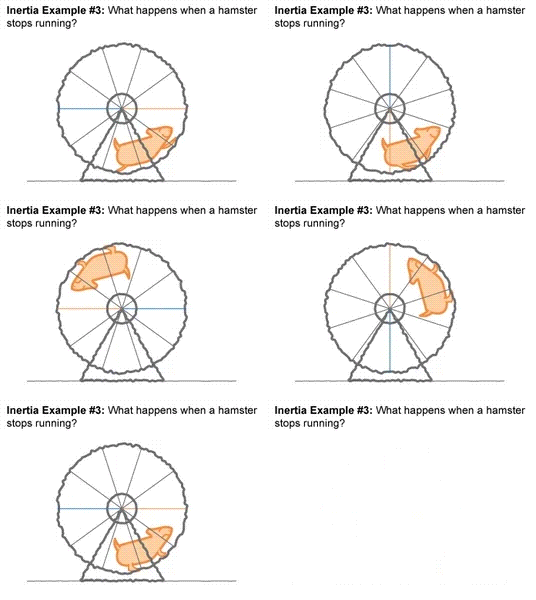
As it turns out, Newton’s law of inertia (which was first formulated by Galileo and then refined by Descartes) makes no distinction between rest and uniform motion in a straight line. And while I realize this is a law of physics not intended to be applied to human motivation or drive, it works for me as a creative exercise. In fact, it pretty much illustrates the human condition. Consider the hamster running on the wheel: it must keep running or else get tossed around by the force of the wheel. Yet it doesn’t get anywhere or have any agency other than to go or to stop. Once our lives get set in motion, it’s easy to get into the same kind of rut as the hamster on the wheel. Afraid to stop, but not feeling as though we have much other choice for action than to get back on the wheel.
At any rate, I like my version better and I am ok with the laziness of my thought and speech with regard to Newton’s laws. Regardless of why a body that is not pushed will eventually come to rest, I wholeheartedly embrace the importance of a body needing a push in order to move – or in my case – act. It’s the reason why I can’t get into a yoga or workout routine in the comfort (aka stasis) of my own home; it is the reason why I seek community for physical activity, whether it’s taking a yoga class with a friend or joining a crossfit gym. My irreverent application of Newton’s law is the reason why I should seek out a writer’s workshop or, in the past, have taken classes in order to do the thing I most want to do. And it’s perhaps the reason why I prefer my life to be a little chaotic: for me, inertia is the 8th deadly sin. I fear stasis more than I fear entropy. In fact, perhaps it is the human condition to “rage, rage against the dying of the light”–Dylan Thomas’s response to the entropy of aging and death.
But raging against the dying of the light requires more than just forward movement – it requires constant reassessment, altering course, finding novel ways of existing in an ever-aging (and deteriorating) physical body. More than one physical therapist has echoed the “motion is lotion” sentiment – movement begets more comfortable movement. But the ways in which we are able to move our aging (or disease-ridden, or accident-recovering) bodies are in a state of flux – not just year to year as we age, but day to day as symptoms flare and subside. And maybe as we get older, more content, the comfort we finally begin to experience in life makes us sedentary. We are no longer trying to escape by running on the hamster wheel but content to burrow into our nests. Despite what we know, we stop moving – and that is the true cause of death. Our human bodies weren’t built to be sedentary, and the ever-changing puzzle of how our muscles and joints perform (and the research and curiosity it takes to figure out how to compensate for these changes) keeps our brains engaged. We may not be able to conquer entropy, but by refusing to stand still, we rewrite the laws of our own universe.
 (mostly) full disclosure